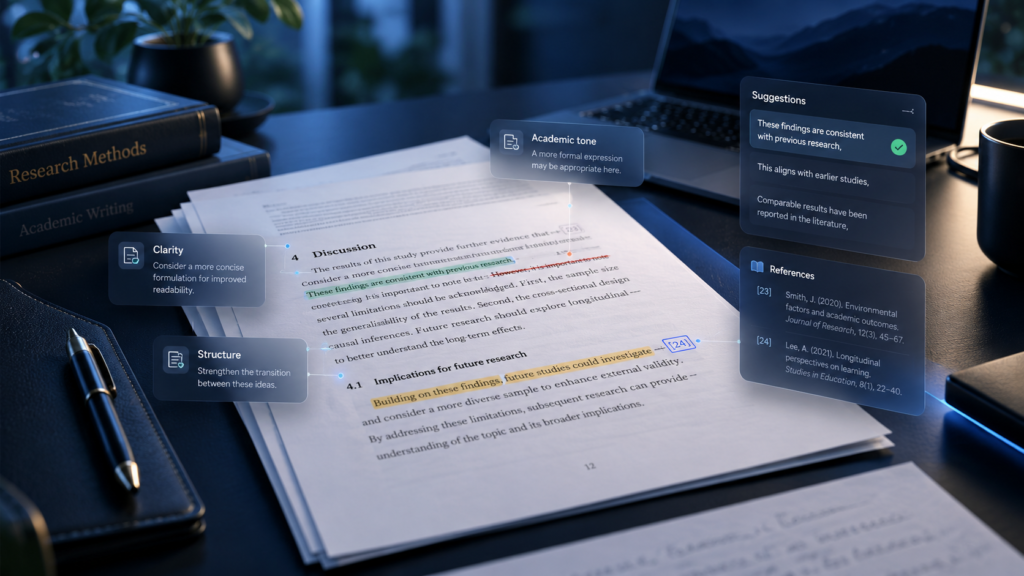
Academic Editing Services
Our academic editing services help you present your existing work with greater clarity, precision and polish. A professional academic editor reviews your writing for readability, academic language, structure, consistency, citations and presentation, so your research reads the way you intend it to.
Support is available for university students, postgraduate and Master’s students, PhD students and researchers. Throughout the process, your ideas, arguments, research and academic voice remain entirely your own.
- Academic Editing
- Proofreading
- Citation Checking
- Formatting Support
Professional Academic Editing and Proofreading
Good academic writing depends on more than good ideas. Even strong research can lose impact when sentences are overlong, terminology shifts between sections, or references do not match the citations in the text. Professional academic editing addresses these issues so readers can focus on the substance of your work.
There is an important difference between improving academic writing and changing what a writer is saying. Our academic editing service works with the words already on the page. An editor may suggest a clearer sentence, a more precise term or a smoother transition, but the argument, evidence, interpretation and conclusions belong to you.
Alongside editing, our academic proofreading services provide a careful final check of language and presentation, helping you catch the small errors that are easy to miss after many rounds of revision.
Changes are typically returned as tracked edits and comments, so you can see exactly what has been suggested and why. This makes the process transparent and keeps you in charge of the final text, which is especially important for work that will be assessed or published under your name.
Editing may focus on
- Clarity
- Academic tone
- Sentence structure
- Logical flow
- Consistency
- Grammar
- Punctuation
- Terminology
- Formatting
- Citations and references
What Our Academic Editors Review
Each document is different, so the depth of review depends on the service you request and the areas you want addressed.
Academic Language and Clarity
We improve readability through better sentence construction, precise word choice and concise phrasing. Wordy or ambiguous passages are refined so your points come across directly, in an appropriate academic tone.
Structure and Logical Flow
Editors check paragraph development, transitions between ideas, the progression of your argument and the organisation of sections, flagging where the reader may lose the thread or where order could be clearer.
Grammar, Spelling and Punctuation
Careful proofreading corrects grammatical errors, spelling mistakes, punctuation problems and sentence-level inaccuracies, including subject–verb agreement, article use and consistent spelling conventions.
Citations and References
We check that in-text citations match your reference list and that entries follow your required citation style consistently. Missing details or mismatches are flagged for you to resolve using your own sources.
Academic Formatting
Formatting support covers headings, line spacing, tables, figures, captions, margins, page and section numbering, and the specific layout instructions set by your university or department.
Consistency and Terminology
Long documents drift. Editors align capitalisation, abbreviations, technical terminology, tense and stylistic choices across the whole document so it reads as one coherent piece of work.
Research Paper Editing Services
Research papers must communicate complex information precisely. Our research paper editing services help you refine an existing draft so that your methods are easy to follow, your results are reported clearly and your discussion connects findings to the wider literature in a logical way.
Academic paper editing looks at each section in context. An introduction may need a sharper statement of purpose; a literature review may benefit from clearer links between sources; a discussion may repeat points already made in the results. Editors identify these issues and suggest improvements to organisation, academic language and clarity.
Research paper proofreading then provides a final check of grammar, spelling, punctuation, citations and references before you submit or share your paper. If you are still planning or drafting, our guide on how to write a research paper explains the typical structure and what each section should achieve.
Sections we review
- Introduction
- Literature review
- Methods
- Results
- Discussion
- Conclusion
- Citations
- References
Thesis and Dissertation Editing
Longer documents bring their own challenges. Chapters are often written months apart, and small differences in terminology, formatting and referencing accumulate. Thesis editing and dissertation editing focus on bringing the whole document into line so that it reads consistently from the first page to the last.
PhD editing in particular requires attention to specialist terminology, detailed methodology and extensive reference lists, while respecting the originality of the candidate’s research. For a closer look at support for longer projects, see our dissertation editing services.
Because these documents are substantial, it helps to send the full document along with your faculty’s formatting handbook. This allows the editor to review cross-references, the table of contents, lists of figures and tables, and appendix numbering as part of the same consistent pass.
Chapter consistency
Aligned style, tense and structure across chapters.
Academic language
Clear, precise expression at postgraduate level.
Formatting
Headings, tables, figures and front matter checked.
References
Citations and bibliography reviewed for consistency.
Academic Editing for Master’s and PhD Students
Postgraduate writing is expected to handle complex ideas with precision. You may be synthesising a large body of literature, explaining an original methodology or presenting nuanced findings, often under tight deadlines and alongside teaching, work or family commitments.
Professional academic editing gives you a careful second reader. An editor can highlight where an argument becomes difficult to follow, where terminology is used inconsistently, or where formatting departs from your institution’s requirements. You stay in control of every decision, reviewing each suggestion and choosing what to accept.
Many students whose first language is not English also find this support useful for expressing their research with confidence, without changing what they want to say.
Common areas of focus
- Expressing complex arguments clearly
- Readable literature synthesis
- Clear methodology descriptions
- Accurate academic terminology
- Consistency between chapters
- Correct use of citation styles
- University formatting requirements
Academic Editing vs Proofreading
The two services are related but work at different levels. Knowing which you need helps you get the right support.
Academic Editing
Improves how your writing communicates, working at sentence, paragraph and section level.
- Clarity
- Structure
- Sentence construction
- Logical flow
- Academic tone
- Consistency
- Readability
Proofreading
A close final check of surface accuracy, usually once content and structure are settled.
- Spelling
- Grammar
- Punctuation
- Typographical errors
- Final consistency checks
Many documents benefit from both: editing to strengthen clarity and flow, followed by an academic proofreading service to catch remaining errors before submission.
If you are unsure which level of support suits your document, describe where it currently stands, such as an early full draft or a near-final version, and the most suitable option can be discussed before any work begins.
How Our Academic Editing Process Works
A clear four-step process, from your first message to your edited document.
- STEP 01
Send Your Document
Share your document, deadline, citation style, university requirements, and the areas you would like reviewed.
- STEP 02
Requirements Review
The document and instructions are reviewed so the appropriate editing and proofreading support can be identified.
- STEP 03
Professional Editing
The document is reviewed for clarity, academic language, structure, consistency, grammar, formatting, citations, and presentation while preserving the author’s intended meaning.
- STEP 04
Review the Edited Document
Review the suggested changes and use the feedback when preparing the final version of your academic work.
Timeframes depend on the length of your document, the level of editing required and your deadline. Sharing your requirements at the start makes it easier to agree a realistic schedule and to focus the editing where it will be most useful.
Academic Documents We Can Edit
Academic document editing is available for a wide range of written work. In every case, support relates to editing, proofreading and improving material you have already written.
Whether it is a short essay or a full manuscript intended for a journal, the same principles apply: clearer language, consistent style and careful attention to the conventions of your discipline.
- Research Papers
- Essays
- Literature Reviews
- Research Proposals
- Master’s Theses
- PhD Dissertations
- Journal Manuscripts
- Reports
- Case Studies
- Academic Presentations
Citation and Academic Formatting Support
Citation and reference checking is one of the most detail-heavy parts of finishing an academic document. Editors review whether author names, dates, titles, page numbers and punctuation follow the conventions of your chosen style, and whether every in-text citation has a matching entry in the reference list.
Academic formatting support extends to headings, spacing, tables, figures, captions and numbering. Because universities, departments and journals often adapt standard styles with their own rules, please share your institution’s guidelines or style guide wherever they apply. Formatting and citations can then be reviewed against the requirements you actually need to meet, rather than a generic version of the style.
Where a reference is incomplete, the editor will flag it so you can add the missing information from your own sources.
Why Academic Editing Matters
Readers, supervisors and reviewers engage more easily with work that is clear and carefully presented. Editing removes the distractions that stand between them and your ideas.
After weeks or months with a document, it becomes difficult to see it with fresh eyes. An independent professional academic editor reads your work as a new reader would, noticing the gaps, repetitions and inconsistencies that familiarity hides.
Clearer communication of ideas
Precise sentences help your reader follow your reasoning without having to reread.
Easier reading
Smoother transitions and well-paced paragraphs make longer documents less demanding to read.
Better consistency
Terminology, spelling and style stay uniform across sections and chapters.
Stronger presentation
Well-organised headings, tables and figures give your work a structured, considered appearance.
Fewer language errors
Grammar, spelling and punctuation issues are identified before others see your work.
More consistent citations
References and in-text citations align with each other and with your chosen style.
Professional document appearance
A polished, carefully formatted document reflects the effort you have put into your research.
Editing services for students at every level
From undergraduate essays to doctoral chapters, support is matched to the document and its requirements.
Frequently Asked Questions About Academic Editing Services
Academic editing services can include improvements to clarity, grammar, academic language, structure, consistency, formatting and citations, as well as final proofreading. The exact scope depends on the service you request and the areas you would like reviewed, which is why it helps to share your priorities when you get in touch.
Editing is broader. It looks at clarity, sentence construction, flow, tone and consistency across the document. Proofreading normally comes last and focuses on correcting remaining spelling, grammar, punctuation and typographical errors. Many documents benefit from both.
Yes. Editing support is available for existing Master’s and PhD documents, including theses, dissertations and individual chapters. The editor works on language, consistency, formatting and presentation while preserving your research, arguments and academic voice.
Yes. Research paper editing covers existing drafts and can address academic language, structure, clarity, formatting, citations and references, followed by research paper proofreading for a final check of accuracy.
Citation and formatting consistency can be reviewed for APA, Harvard and other common styles. Because institutions often adapt these styles, please provide your university or department guidelines so the review reflects the requirements that apply to you.
No. The purpose of editing is to improve how clearly and correctly your work communicates, not to change what it says. Your intended meaning, arguments and authorship are preserved, and you decide which suggested changes to accept.
Please send your document, your deadline, the citation style you are using, any formatting instructions or university guidelines, and a note of particular areas you would like the editor to focus on, such as flow, academic tone or references.
Ready to Improve Your Academic Document?
Send your document, deadline, and editing requirements to discuss the level of academic editing or proofreading support you need. Our academic editing services are shaped around your document, your guidelines and your priorities.
Academic Editing Services
Improve the clarity, academic language, structure, citations, formatting and proofreading of your existing academic work with our professional editing support.
Explore Academic Editing Services →For university coursework and individual assignments, explore our Assignment Editing Services for proofreading, structure, citation and formatting support.