How to Write a Research Paper
How to Write a Research Paper Step by Step
Writing a university research paper becomes much easier when you break the process into clear stages. This guide explains how to plan your paper, create an outline, write the main sections, present your findings, discuss your research and revise your final draft.
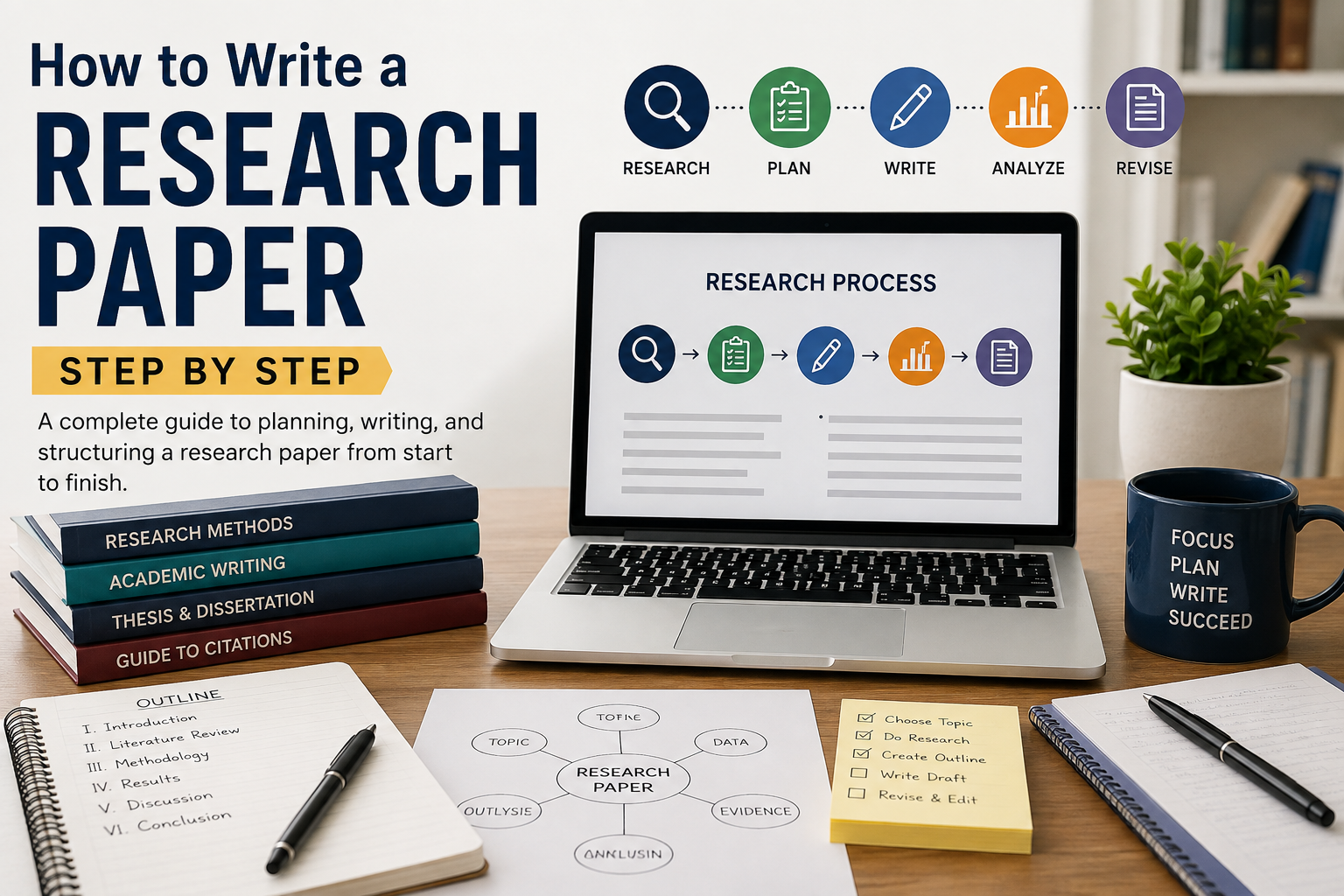
Research Paper Guide at a Glance
What Is a Research Paper?
A research paper is a structured academic document that investigates a question, problem or topic using evidence. Depending on the subject, the evidence may come from experiments, surveys, observations, academic literature, datasets, case studies or other appropriate research methods.
A strong research paper does more than collect information. It presents a clear research purpose, explains how the research was conducted, reports important findings and connects those findings to the wider academic discussion.
1. Plan Your Research Paper Writing Time
One of the most difficult parts of writing a research paper is simply beginning. Instead of waiting until you feel inspired, schedule specific writing sessions and treat them like important appointments.
Short, consistent writing sessions are usually more manageable than trying to complete an entire paper in one long session. Depending on your deadline, you might divide your work into stages such as reading, outlining, drafting, revising and proofreading.
Choose a Productive Time
Work during the part of the day when you can concentrate most effectively. For some students this may be early morning, while others work better in the afternoon or evening.
Separate Writing From Editing
During the first draft, focus on developing your ideas. Constantly correcting every sentence while drafting can slow down the writing process.
2. Create a Research Paper Outline Before Writing
A research paper outline gives your ideas a logical order before you begin writing full sections. It can also help you identify missing information and decide which evidence belongs in each part of the paper.
Start by answering these five questions:
- What is the main topic of the paper?
- Why is this topic important?
- What is the main research question or hypothesis?
- What evidence, data or findings will be presented?
- What is the main conclusion or contribution?
Topic: Social media and student study habits
Research question: How does regular social media use affect university students’ study habits?
Method: Review of peer-reviewed studies and survey data
Main focus: Concentration, time management and study behaviour
Expected conclusion: Social media may have both productive and disruptive effects depending on patterns of use.
Once you have the basic outline, expand it into the major sections required for your assessment or discipline.
3. Understand the Typical Research Paper Structure
Research paper requirements differ across disciplines, but many empirical papers follow a structure similar to the one below.
Introduction
Establish the topic, explain the research context, identify the problem or gap and state the research question or objective.
Materials and Methods
Explain what was studied, what materials or data were used and how the research was conducted.
Results
Present the main findings clearly and logically, using tables, figures or other visuals where appropriate.
Discussion and Conclusion
Interpret the findings, compare them with previous research, explain limitations and describe the significance of the work.
4. How to Write the Materials and Methods Section
If you find it difficult to begin your research paper, the Methods section can sometimes be a useful starting point because much of the information should already exist in your notes, research plan or project documentation.
The purpose of this section is to explain the research process clearly enough for the reader to understand how the study was carried out and, where appropriate, evaluate or reproduce the approach.
Include Relevant Methodological Details
- Research design or overall approach
- Participants, samples, datasets or study materials
- Equipment, software or research instruments
- Data collection procedures
- Variables or measurements
- Data analysis methods
- Relevant ethical procedures where required
Keep the Point of View Consistent
Follow the conventions of your subject and your university’s guidance on active and passive voice. Whichever style you use, avoid switching unnecessarily between different points of view within the same paragraph, because this can reduce clarity.
5. How to Write the Results Section of a Research Paper
The Results section presents the findings produced by your research. The information should be organised in a logical sequence so the reader can understand which findings are most important.
Present Results in a Clear Order
Consider organising the Results section around research questions, experiments, themes or major findings. Each subsection should have a clear purpose.
Tables and figures can be useful when they make complex information easier to understand. However, the text should highlight the important message rather than simply repeat every number shown in a table.
Use Direct and Objective Language
Avoid unnecessary wording and exaggerated expressions. Phrases such as “clearly proves” or “it is obvious” may make academic claims sound stronger than the evidence supports. Instead, describe what the evidence demonstrates as precisely as possible.
6. How to Write a Research Paper Introduction
The introduction guides the reader from the broad research area toward your specific research problem. A useful way to structure it is to move through three stages.
Establish the Research Area
Explain the general topic and why it is important. Introduce relevant background research so the reader understands the academic context.
Identify the Research Gap or Problem
Show what remains uncertain, under-researched, disputed or incomplete in existing research.
Explain Your Research
State the purpose of your study, research question or hypothesis and, where appropriate, briefly indicate your approach and contribution.
Research area → Existing knowledge → Research gap → Research question → Purpose of the study
Keep the introduction focused. Its purpose is not to include everything you know about the topic, but to give the reader enough context to understand why your research was necessary.
7. How to Write the Discussion Section
The Discussion section explains what your findings mean and how they fit into the wider research literature. Instead of simply repeating the Results section, interpret the findings and connect them back to the research question.
Start With the Main Findings
Briefly remind the reader of the most important findings and explain why they matter.
Place the Findings in Research Context
Compare your findings with previous studies. Explain areas of agreement, disagreement or unexpected results and discuss possible reasons for those differences.
Discuss Limitations
Strong academic writing acknowledges the limitations of the research. These may involve sample size, research design, available data, measurement limitations or other factors that affect how widely the results can be interpreted.
Finish With the Research Contribution
Explain what the findings contribute to the topic and, where appropriate, identify practical implications, recommendations or areas for future research.
Main finding → Meaning → Comparison with previous research → Alternative explanation → Limitations → Implications → Final conclusion
8. Revise Your Research Paper in Two Stages
The first draft is only the beginning. Revision improves both the overall argument and the clarity of individual sentences.
Stage 1: Review the Overall Structure
First examine the paper as a whole. Check whether the research question, evidence, results and discussion are logically connected.
- Does every major section have a clear purpose?
- Does the introduction lead naturally to the research question?
- Are the Methods detailed enough?
- Are the Results presented logically?
- Does the Discussion answer the research question?
- Is important information missing or repeated?
Stage 2: Edit Paragraphs and Sentences
Once the structure is working, focus on sentence-level improvements such as grammar, punctuation, word choice, repetition and clarity.
Reading the paper aloud can help you notice sentences that are too long, awkward or difficult to follow. You can also search for words or phrases you tend to overuse.
9. Common Research Paper Writing Mistakes
- Starting without a clear research question or outline
- Trying to write and perfect every sentence at the same time
- Including information that does not support the research purpose
- Writing vague descriptions of research methods
- Repeating every figure or table value in the Results section
- Mixing results and interpretation without following disciplinary requirements
- Making claims that are stronger than the available evidence
- Failing to explain how findings relate to previous research
- Ignoring limitations or unexpected results
- Leaving editing and referencing until the final few hours
10. Research Paper Checklist
Before submitting your research paper, check that you have:
- Clearly stated the topic and research question
- Explained why the research topic is important
- Used a logical research paper structure
- Included credible and relevant academic sources
- Explained the research methodology clearly
- Presented the important findings accurately
- Used tables and figures only where they improve understanding
- Connected the Discussion to the research question
- Explained limitations and implications where appropriate
- Checked the required referencing style
- Reviewed grammar, spelling and sentence clarity
- Checked the assignment brief and marking criteria
Frequently Asked Questions About Research Papers
What is the first step in writing a research paper?
Start by understanding the assessment requirements, choosing a focused topic and defining the research question. Creating an outline before drafting can make the writing process much easier.
Which section of a research paper should I write first?
You do not always have to write the paper in reading order. In empirical research, some students find it easier to begin with the Methods or Results because the relevant information is already available from their research notes.
What are the main sections of a research paper?
Many research papers include an Introduction, Methods, Results, Discussion, Conclusion and References. However, the exact structure depends on the discipline and assessment instructions.
How can I make my research paper clearer?
Use a strong outline, organise one main idea at a time, remove unnecessary wording, explain important evidence directly and revise both the overall structure and individual sentences.
How many times should I revise a research paper?
There is no fixed number. Complex research papers often require several rounds of revision. Focus first on argument and organisation, then improve paragraphs, sentences, grammar and formatting.
Continue Learning With Our Student Resources
If you are working on university research or an assignment, you may also find our assignment proposal guide useful. Online Assignment Support provides academic guidance with planning, research direction, structure, editing, proofreading and referencing.